Why Benefits Realisation Should Start Before a Project Ends
A project can finish on time, stay within budget and still fail to deliver the value it was meant to create.
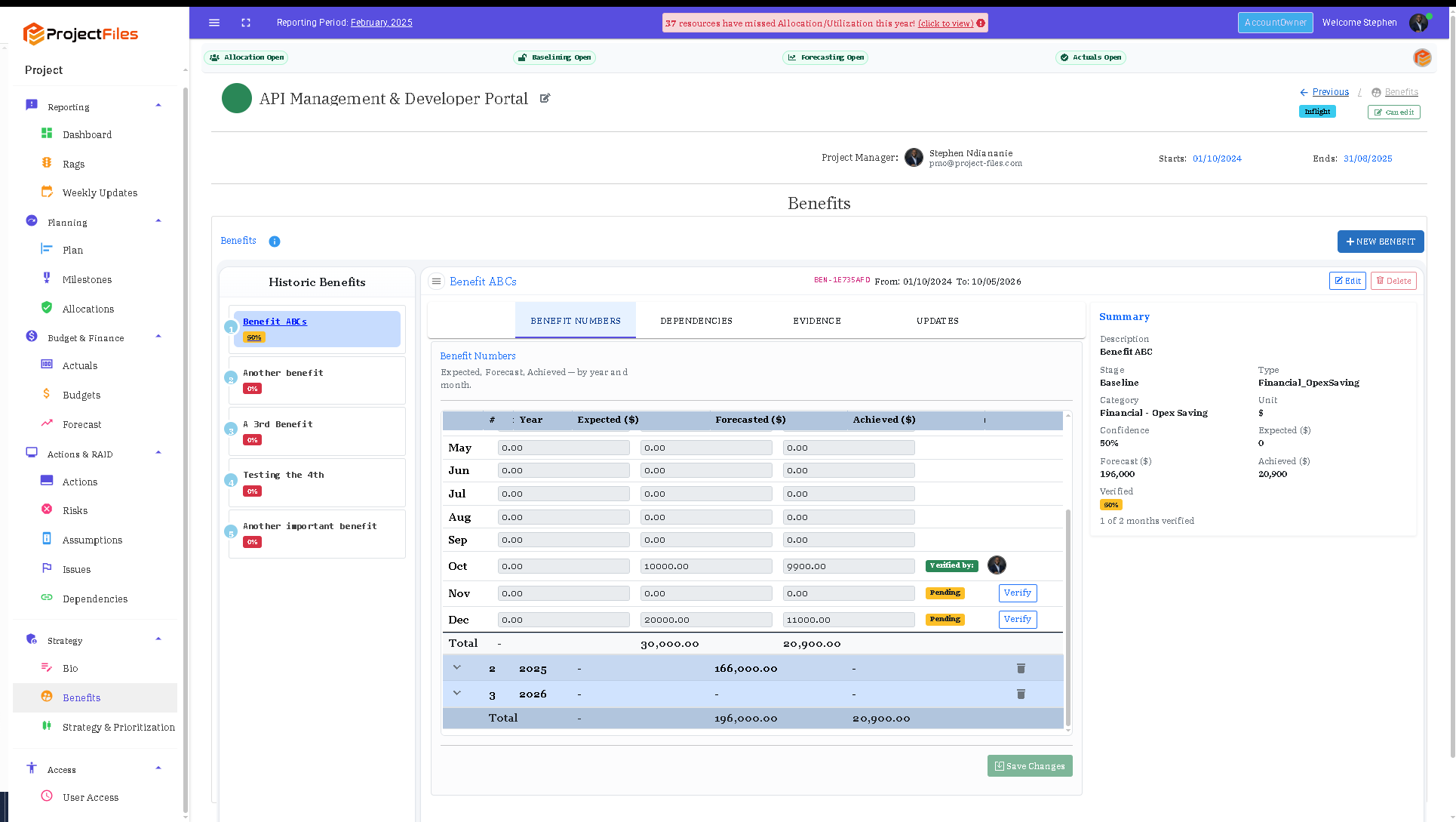
Benefits realisation tracking expected project value against actual outcomes
That is the uncomfortable bit.
We often celebrate delivery first and ask about benefits later.
But by then, it can be too late.
A project is not successful simply because it was completed.
It is successful when the organisation gets the outcome it invested in.
Benefits should not be an afterthought
Imagine approving a project because it is expected to save £500,000 a year.
The project gets delivered.
Everyone moves on.
Six months later, someone asks:
Did we actually save the £500,000?
Nobody is quite sure.
That is not really benefits management.
That is archaeology.
Benefits should be defined before delivery starts, not reconstructed afterwards.
Start with the reason the project exists
Every project should be able to answer:
What value are we expecting this investment to create?
That might be:
reduced cost;
increased revenue;
faster processing;
improved customer experience;
reduced risk;
better compliance;
improved productivity; or
increased capacity.
The important thing is that the expected benefit is clear enough to measure.
“Improve efficiency” is difficult to govern.
“Reduce processing time from five days to two” is much easier.
Give every benefit an owner
A benefit without an owner has a good chance of becoming nobody’s responsibility.
The project manager may deliver the capability, but the benefit often sits with the business.
For example, installing a new system may be the project’s responsibility.
Actually using it to reduce operating cost may belong to the business owner.
That distinction matters.
Delivery creates the capability.
The business realises the benefit.
Track benefits during delivery
You do not need to wait until project closure to ask whether the benefit is still realistic.
If costs increase significantly, the business case may weaken.
If scope is reduced, the expected benefit may reduce too.
If the delivery date moves six months, the benefit may arrive six months later.
This means benefits should be reviewed alongside:
scope;
cost;
forecast;
risks;
delivery dates; and
major decisions.
The business case should not stay frozen while everything around it changes.
Separate delivery from value
A simple metaphor:
Building the bridge is delivery.
People actually using the bridge to reach somewhere faster is the benefit.
You need both.
A project can deliver exactly what was requested and still fail to create enough value.
That is why portfolio governance should look beyond completion dates and budget performance.
Review benefits after delivery too
Some benefits will only appear after the project has closed.
That is normal.
What matters is that somebody still owns the measurement.
A sensible benefits review should ask:
Did the expected benefit happen?
Was it greater or smaller than expected?
What evidence supports the result?
Has the benefit been sustained?
What should we learn for future investment decisions?
That closes the loop between strategy and delivery.
The key takeaway
Benefits realisation should begin before the project starts and continue after delivery ends.
Define the expected value.
Give it an owner.
Track whether it is still realistic.
Then verify whether it actually happened.
Otherwise, organisations risk becoming very good at delivering outputs without knowing whether those outputs created enough value.
Put stronger benefits governance into practice
ProjectFiles connects strategic objectives, prioritisation, project delivery and benefits tracking in one governed environment.
Clarity. Control. Confidence.
Numbers that hold up when challenged.