Project Financial Management: How to Control Budgets, Forecasts and Actuals
Project financial management can sound like a finance function.
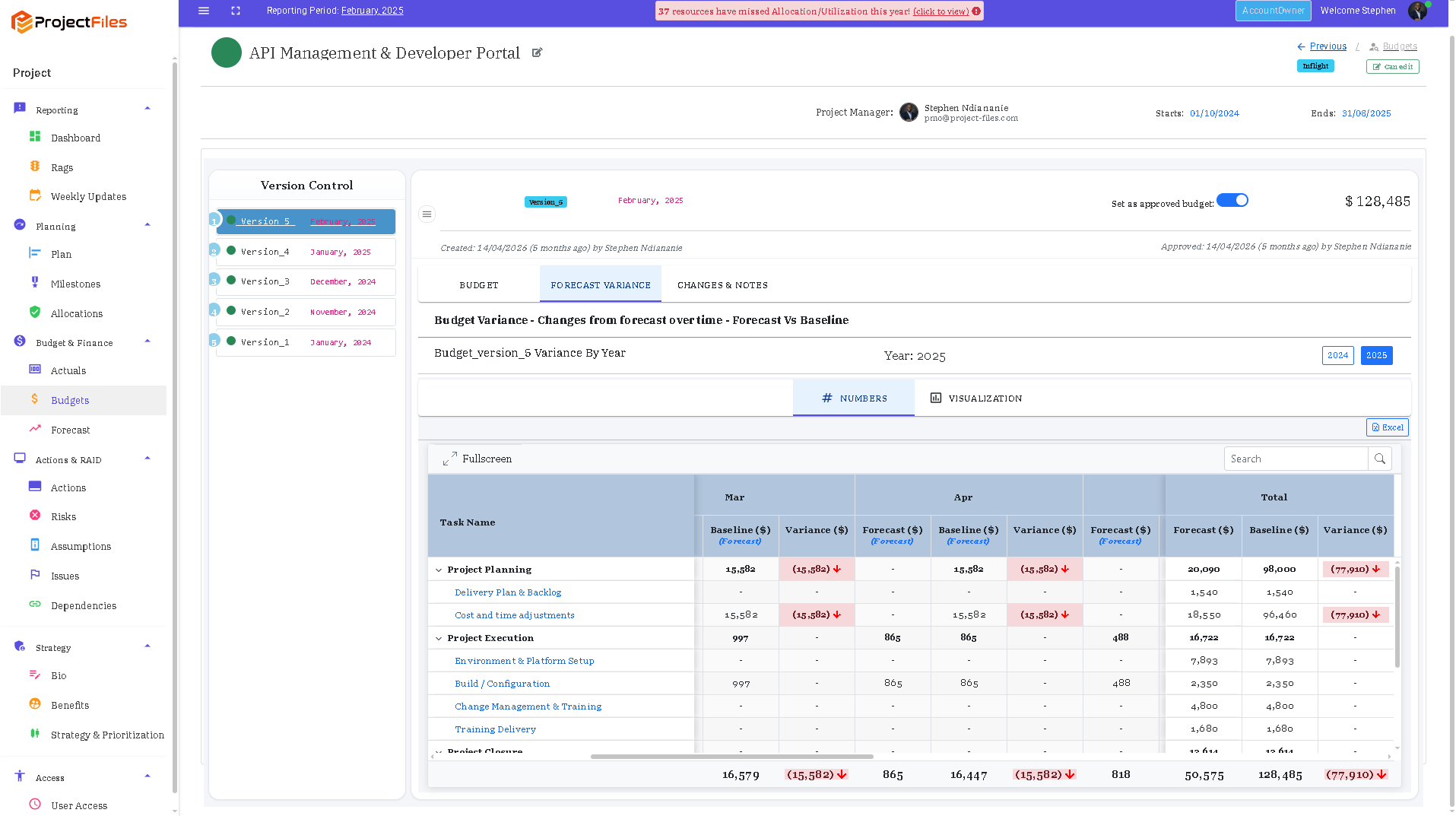
Project financial management comparing budget forecast and actual project costs
In practice, it is a delivery function too.
Because every project decision eventually shows up somewhere in the numbers.
Add a contractor and the forecast changes.
Move a milestone and the timing of spend may change.
Delay work and costs may move into another month.
Increase scope and the expected final cost may rise.
The problem starts when budgets, forecasts and actuals are managed as separate things.
Budget, forecast and actuals are different
A simple way to think about them:
Budget is what you were authorised to spend.
Forecast is what you now expect to spend.
Actuals are what you have already spent.
They should relate to each other, but they are not interchangeable.
If a project has a £500k budget, that does not mean the latest forecast should always stay at £500k.
If the expected cost has changed, the forecast should show it.
Otherwise, the organisation is not forecasting. It is protecting the original number.
The forecast should tell the current truth
A good forecast should answer:
Based on what we know today, what do we genuinely expect this project to cost?
That means updating it when:
resource assumptions change;
supplier costs change;
scope changes;
timing changes;
actual spend differs from expectation; or
new risks become real financial exposure.
The forecast should move when reality moves.
That is not bad control.
That is good control.
Actuals should challenge the forecast
Actuals are not just historical numbers to upload at month-end.
They are evidence.
If actual cost is higher than forecast, ask why.
Was something posted early?
Was there more effort than expected?
Was the cost coded incorrectly?
Has the project genuinely become more expensive?
The key question is not only:
Why was there a variance?
It is:
What does this mean for the remaining forecast?
That is where financial control becomes useful.
Do not let the three numbers drift apart
The danger comes when budget, forecast and actuals live in different spreadsheets, systems or reporting cycles.
Then you get conversations like:
“Finance has one number.”
“The PM has another.”
“The portfolio report says something else.”
At that point, the issue is not arithmetic.
It is control.
A stronger process keeps all three connected and traceable.
Keep the baseline visible
The original approved budget or baseline still matters.
It gives you something to measure against.
But it should not be overwritten every time the project changes.
Otherwise, history disappears.
A better approach is to keep the approved baseline, track the current forecast against it, and formally rebaseline only when governance agrees that the approved position genuinely needs to change.
That gives you two useful views:
Where did we start?
and
Where do we now expect to finish?
Monthly control should connect the numbers
A practical monthly financial cycle looks like this:
Forecast → Actuals → Reconcile → Reforecast → Review → Approve → Close
That cycle creates discipline.
It means actual performance informs the future, rather than simply being explained after the event.
The key takeaway
Good project financial management is not about forcing the numbers to match the budget.
It is about making sure the numbers tell the truth.
The budget tells you what was approved.
The forecast tells you what you now expect.
The actuals tell you what has happened.
When those three stay connected, management can make better decisions before problems become surprises.
Put stronger financial controls into practice
ProjectFiles connects project budgets, forecasts, actuals, reconciliation, approvals and monthly close in one governed environment.
Clarity. Control. Confidence.
Numbers that hold up when challenged.