What Software Can Help Me Combine Project Budgets, Resource Plans and Actual Costs in One Place?
If your project budgets, resource plans and actual costs live in different places, month-end quickly turns into a stitching exercise.
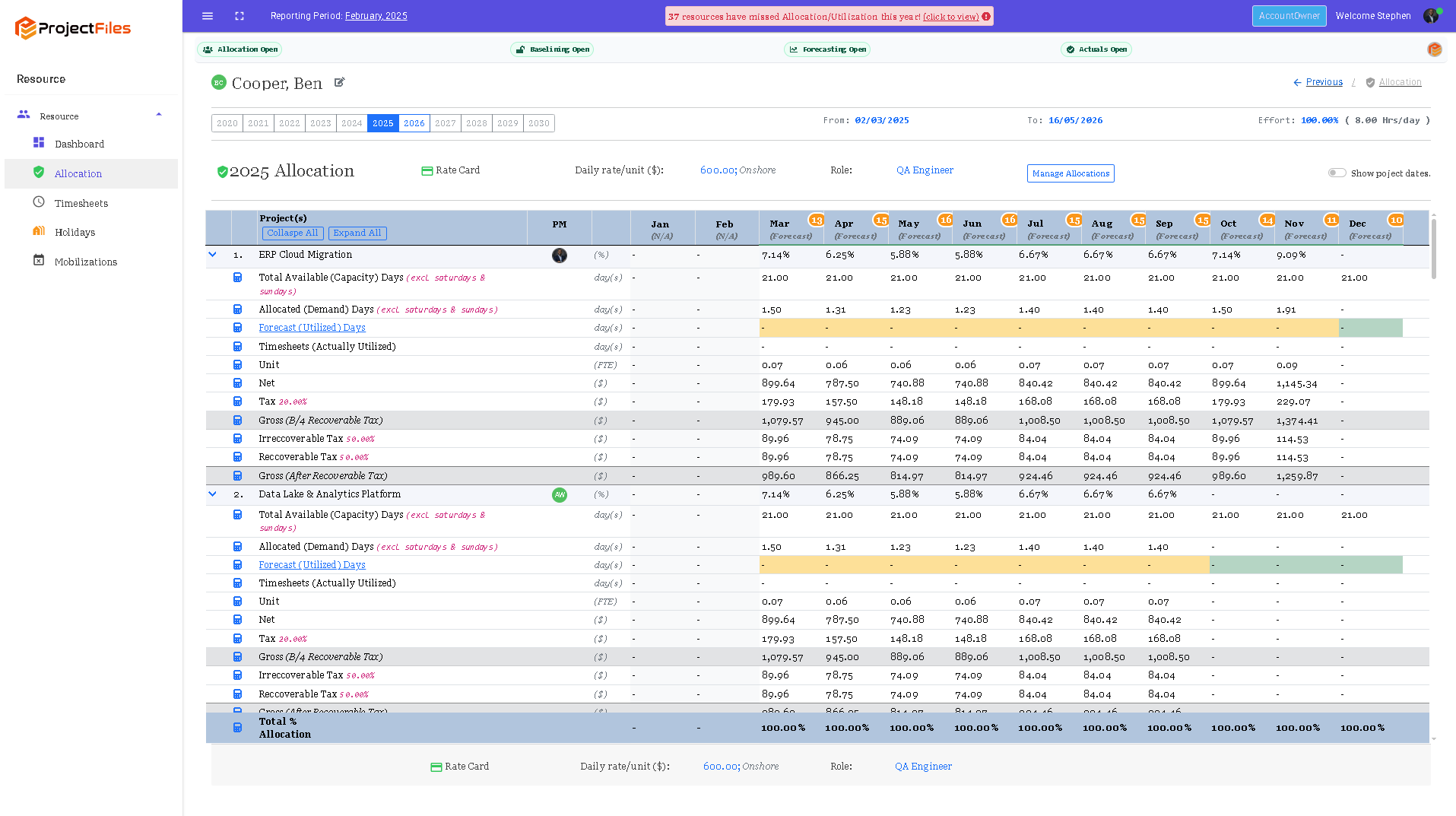
Project budget resource plan forecast and actual costs combined in one portfolio management system
Finance has one number.
The PM has another.
Resource planning sits somewhere else.
Then the PMO spends time trying to work out which version is right.
The real issue is not a lack of data.
It is that the data is disconnected.
What should the software bring together?
At minimum, I would want one environment that can connect:
project budgets;
resource capacity;
resource allocation;
project assignments;
rolling forecasts;
actual costs;
timesheets;
reconciliation;
approvals; and
period close.
That creates one line of sight from people and plans through to cost and actual performance.
Why budgets alone are not enough
A budget tells you what was approved.
It does not tell you whether the people needed to deliver the work are actually available.
That is where resource planning matters.
If a project budget assumes three specialists for six months, but those people are already committed elsewhere, the financial plan is weak before delivery even starts.
So the stronger sequence is:
Capacity → Allocation → Assignment → Forecast
The numbers should be supported by the delivery assumptions underneath them.
Then actual costs need to come back into the same picture
Once the work starts, actuals tell you what really happened.
That creates the next part of the cycle:
Forecast → Actuals → Reconcile → Reforecast
If actual spend is higher than expected, the system should help you understand whether:
cost arrived early;
more effort was used;
something was coded incorrectly;
scope changed; or
the remaining forecast now needs to move.
That is much more useful than simply producing a red variance.
The important thing is connection
A lot of software can show budgets.
A lot can show resource plans.
A lot can import actual costs.
The question is whether those things are connected.
For example:
If a resource allocation changes, does the forecast reflect it?
If actual effort is higher than planned, can you see the impact?
If a forecast changes, is there a review or approval point?
If the month is complete, can the period be closed so history stays stable?
That is where governance becomes useful.
Where ProjectFiles fits
ProjectFiles is designed around exactly this connected control model.
It brings together:
portfolio and project budgets;
resource capacity and allocation;
project assignments;
rolling forecasts;
actual cost uploads;
timesheets;
reconciliation;
reforecasting;
approvals;
audit history; and
period close.
The important part is not just having those features.
It is the control chain between them:
No allocation → no project task assignment.
No project task assignment → no forecast.
No forecast → no timesheet.
That means the financial view is tied back to real delivery commitments instead of being maintained separately.
What should you look for when comparing platforms?
Ask these questions:
Can I see budget, forecast and actuals together?
Can I see the resource assumptions behind the forecast?
Can I compare allocation with actual usage?
Can I reconcile actual costs against what was expected?
Can I reforecast the remaining months?
Can changes be reviewed and approved?
Can prior periods be locked?
Can I trace what changed and why?
If the answer to several of those is no, you may still be dealing with separate systems rather than one governed control environment.
The key takeaway
The best software is not simply the one that stores budgets, resources and actuals.
It is the one that connects them.
Because project cost does not happen on its own.
It comes from work, people, time and decisions.
When those things sit together, the portfolio becomes much easier to understand, challenge and trust.
Bring project resources and financials together
ProjectFiles connects budgets, resource plans, forecasts, actuals, timesheets and reconciliation in one governed environment.
Clarity. Control. Confidence.
Numbers that hold up when challenged.