What a Good Monthly Project Control Cycle Actually Looks Like
A monthly project control cycle should do more than produce a report.
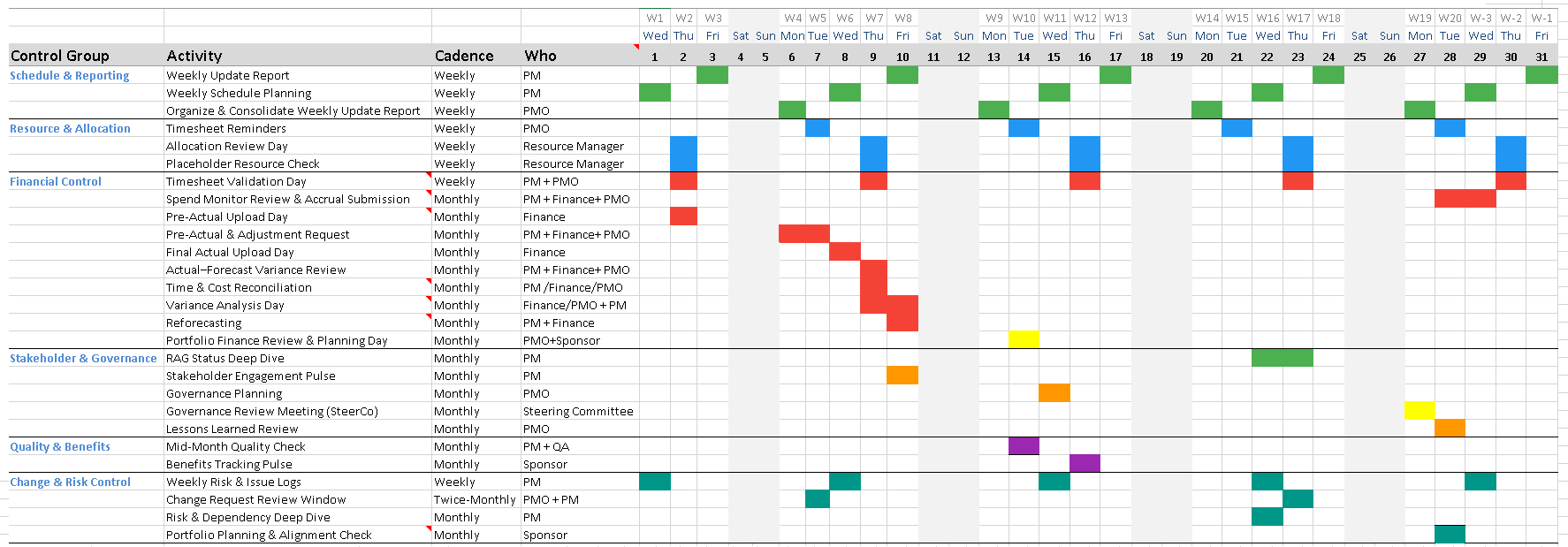
Monthly project control cycle covering forecast actuals reconciliation review approval and close
It should create a repeatable way to review what happened, understand what changed, correct the future and lock in a trusted position for the next month.
When that rhythm is weak, teams spend too much time chasing inputs, reconciling spreadsheets and explaining numbers that are already out of date.
A strong monthly control cycle is much simpler.
It connects the operational and financial parts of the project into one governed sequence.
Start with capacity and allocation
Before reviewing forecasts, the organisation should understand whether the right resources are actually available and committed.
That means checking:
current capacity;
project allocations;
upcoming resource conflicts; and
any placeholder requirements that still need to be filled.
If resource assumptions are wrong, the forecast will eventually be wrong too.
Review the plan
The delivery plan should reflect the current reality of the project.
Ask:
Has the timing changed?
Has the scope changed?
Have assignments changed?
Are dependencies still valid?
Is the remaining work still achievable?
The plan should describe the work the team genuinely expects to complete.
Review the forecast
Once the plan is current, the financial forecast should be checked against it.
The forecast should answer:
What do we expect to spend?
When do we expect to spend it?
What is driving that cost?
Has the expected total changed?
Are resource assumptions still valid?
The forecast should be the financial expression of the remaining work.
Load actuals
Actual costs and recorded time then provide evidence of what really happened.
This is where the monthly cycle moves from expectation to fact.
The team should compare actuals against what was previously forecast.
That makes the variance visible.
Reconcile the difference
The next step is not simply to write commentary.
It is to understand the reason for the difference.
Was the cost:
early;
late;
higher than expected;
lower than expected;
incorrectly coded; or
caused by a genuine change in delivery?
The answer matters because it determines what should happen next.
Reforecast the future
Once the variance is understood, the remaining forecast should be corrected.
If spend came forward, future months may reduce.
If additional work has been introduced, the total forecast may increase.
If a resource has moved, the timing and cost profile may need to change.
This is the point where good control turns historical information into a better future view.
Review and approve
Material changes should then be reviewed by the appropriate people.
That may include the project manager, PMO, finance partner, resource manager or sponsor.
The objective is to reach one agreed position.
Not five versions of the same forecast.
Close the period
Once the monthly position has been reviewed and approved, the period should be closed.
Prior periods should not continue changing without control.
This creates a stable history and makes month-on-month comparison meaningful.
It also helps answer a critical question:
What changed since the last approved position?
The full monthly flow
A strong monthly control cycle looks like this:
Capacity → Allocation → Plan → Forecast → Actuals → Reconcile → Reforecast → Review → Approve → Close
Each stage supports the next.
That is what turns project reporting into project governance.
The key takeaway
A good monthly control cycle is not about producing more reports.
It is about creating a disciplined rhythm where plans, resources, forecasts, actuals and approvals stay connected.
When that happens, monthly reporting becomes easier.
More importantly, the numbers become easier to trust.
Put stronger monthly controls into practice
ProjectFiles connects capacity, allocation, planning, forecasts, actuals, reconciliation, approvals and period close in one governed environment.
Clarity. Control. Confidence.
Numbers that hold up when challenged.