Why Monthly Project Reconciliation Is So Painful — and How to Fix It
Monthly project reconciliation is often one of the most frustrating parts of project control.
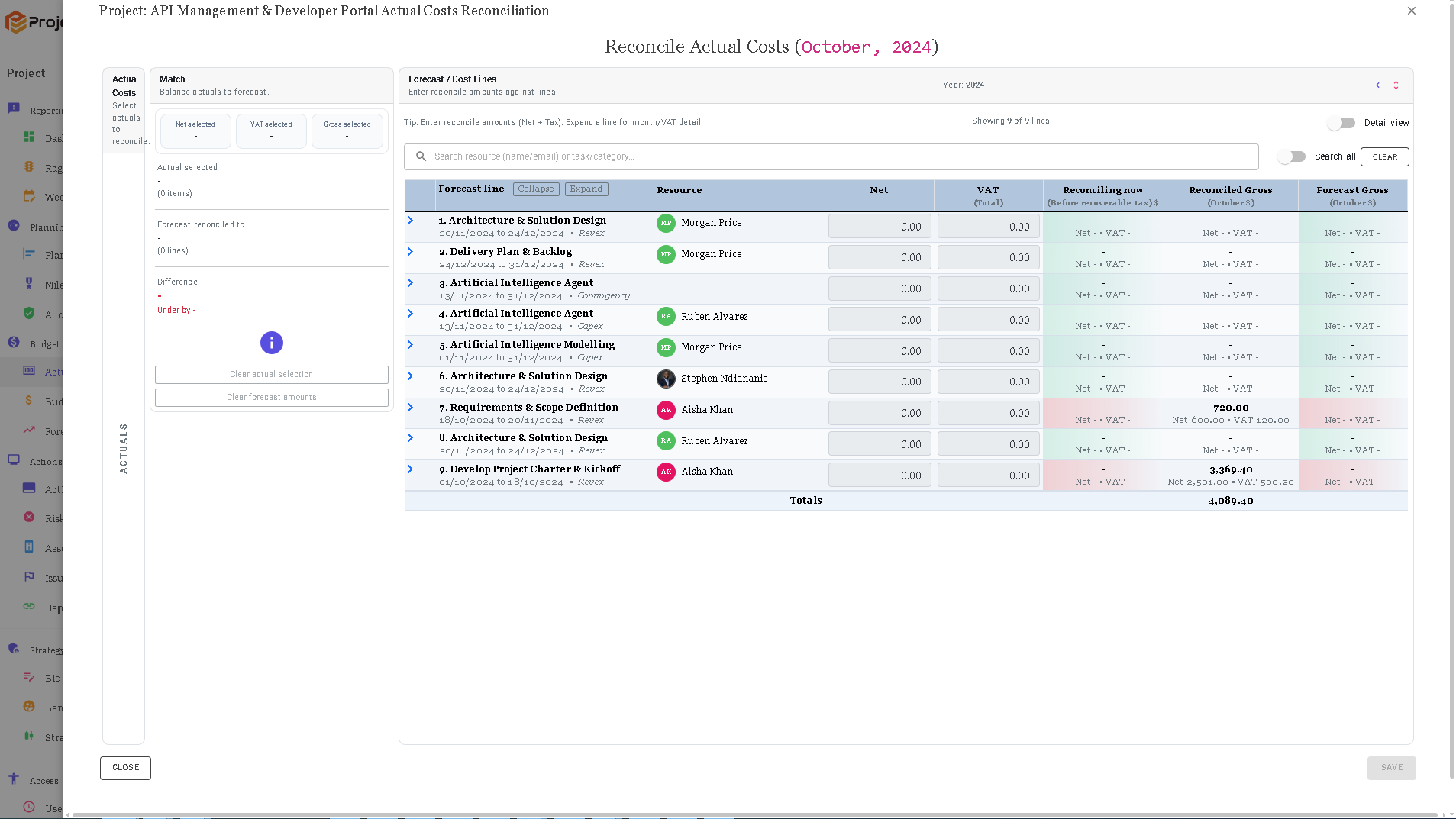
ProjectFiles reconciling actual costs with forecast to expose gaps and make decisions for the future.
Actuals arrive late. Timesheets do not match planned effort. Forecasts are still sitting in spreadsheets. Finance has one number, the PM has another, and the PMO is left trying to explain the difference before the reporting deadline.
The problem is not reconciliation itself. The problem is that the information needed to reconcile is usually spread across too many places.
When actuals, forecasts, time, resource allocation and project plans are disconnected, every month becomes a manual investigation.
Reconciliation should answer one simple question
What changed between what we expected and what actually happened?
That means comparing:
forecast cost against actual cost;
planned effort against recorded time;
allocated capacity against actual usage;
expected timing against actual timing; and
previous assumptions against current reality.
If those comparisons are easy to make, reconciliation is straightforward.
If they are not, the monthly close becomes painful.
The first problem: actuals arrive without context
A cost appears in the ledger, but nobody knows immediately why it is different from the forecast.
Was it posted early?
Was it delayed from last month?
Was it coded incorrectly?
Did the project genuinely spend more than expected?
Without context, teams waste time chasing explanations.
A better process is to load actuals into the same control environment as the forecast, then review the difference line by line where necessary.
The aim is not just to explain the past.
It is to decide whether the future forecast now needs to change.
The second problem: time and cost do not reconcile
Projects often track labour effort and financial cost separately.
That creates gaps.
A person may record more time than planned, but the cost forecast remains unchanged.
Or the cost appears in the finance system, but the associated time has not been recorded properly.
Reconciliation should connect the two.
If time changes materially, cost should be checked.
If cost changes materially, the underlying work should be checked.
That is how organisations move from reporting numbers to understanding them.
The third problem: reconciliation stops at variance commentary
Many monthly reports end with an explanation such as:
“Spend was higher than forecast due to additional contractor effort.”
That may be true, but it is incomplete.
The real question is:
What does that mean for the remaining forecast?
If the overspend has already consumed part of the future budget, the forecast should change.
If the cost was simply brought forward, the remaining months may reduce.
If the issue is temporary, the total forecast may stay the same.
Strong reconciliation turns variance into action.
A better monthly control cycle
A practical monthly flow is:
Actuals → Reconcile → Adjust → Reforecast → Review → Approve → Close
That means:
upload actual costs;
compare them with the previous forecast;
review time and cost differences;
correct coding or timing issues;
update the remaining forecast;
review material changes;
approve the current position; and
close the period.
Once the period is closed, prior months should normally remain controlled and traceable.
That gives the organisation a stable history and a much clearer view of what changed from month to month.
Reconciliation becomes easier when the data is connected
The monthly close should not depend on somebody manually stitching together five different spreadsheets.
When allocation, plans, forecasts, timesheets and actuals are connected, the questions become much easier to answer.
You can see what was expected.
You can see what happened.
You can see the difference.
And most importantly, you can correct the future.
That is the real purpose of reconciliation.
Put stronger monthly controls into practice
ProjectFiles connects forecasts, actuals, time, resource allocation, reconciliation, approvals and period close in one governed environment.
Clarity. Control. Confidence.
Numbers that hold up when challenged.